
Zoom Recital
A piece I wrote in 2020 and never shared…

I was writing this morning, and started to write about piano, and then remembered that I’d written this just over 6 (!!) years ago and never shared it, probably because I was still in contact with my Dad.
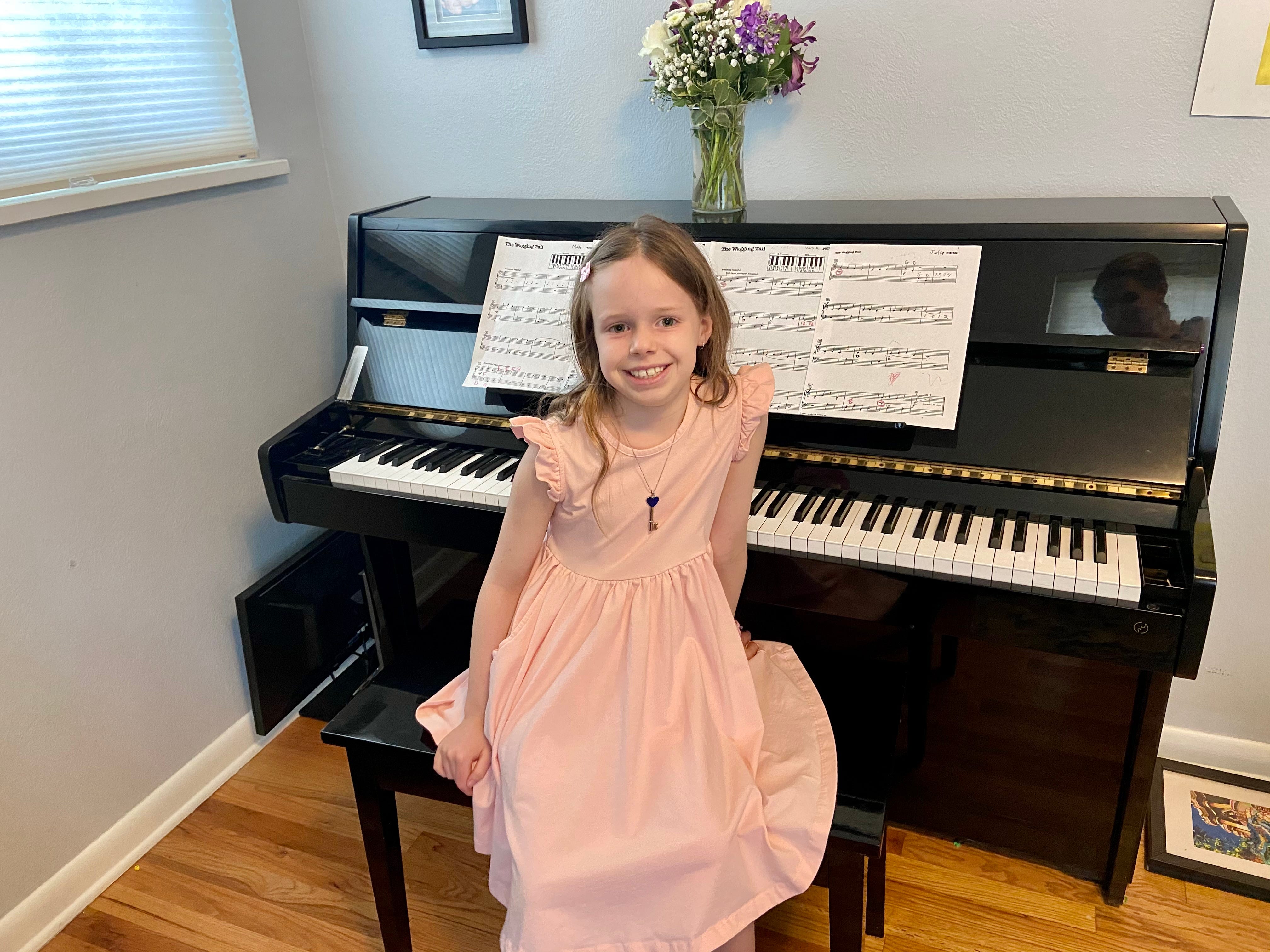
Despite her hesitation to engage in remote learning, my eight-year-old daughter embraced her Zoom piano lessons during quarantine. This shocked me; she started playing in February of 2020, and after only a few lessons, they made the switch online in March. Piano anchored her as the world she knew changed; her dance recital canceled, her time with her beloved second grade class over, and family visits postponed. Piano, however, continued, and when my daughter’s teacher asked if she would like to do a Zoom recital to commemorate the end of the school year, she pumped her fist and exclaimed, “Yes!” She asked if she could get a new dress (yes), a new hairbow (okay, I guess so), and send evites (okay, why not?).
When I asked who she wanted to invite, my daughter named her second grade teacher, two friends, my brother and his family, and “all of her grandparents.” I clarified that she really meant all of her grandparents, and not just my mom and stepdad and my in-laws, and she told me that she wanted to invite my dad and my stepmom, too. I had noticed a difference in boundaries during quarantine. While we had not seen family in person (they’re two thousand miles away), my dad and stepmom had more access to us than usual. They watched both of the virtual Listen to Your Mother shows I produced and performed in, and when they asked to FaceTime (thankfully only a couple of times) I wasn’t able to make excuses. During quarantine, I couldn’t claim to be busy.
The day of the recital, my mom texted me: Are your dad and stepmom going to be on the piano Zoom call? I replied yes with the “eek” emoji- a yellow face with a tight grimace. My daughter chose her jewelry and pinned back her bangs, now in the awkward stage after three months without a trim during lockdown. She did a twirl in her dress and prepared her American Girl Samantha doll to watch her. I wondered how it would go. Group calls had been hard for her during remote learning, and would it be weird for her to be on a call with her teacher, her divorced and remarried grandparents, her friends, and various other family members? I’m probably just projecting, I thought, as I noticed my armpits were sweating.
We signed on, and as I introduced my daughter’s piano teacher to everyone, I thought about how I had forgotten to tell our wedding photographer that my dad and I had a complicated relationship. He took tons of pictures of my dad at the reception, recording what would be typical “father of the bride” shots: my dad laughing during the toasts; my dad and my stepmom on the dance floor; my dad giving a tired expression, as if he’d just raised a daughter and had experienced a monumental change as she walked down the aisle, a simplified and inaccurate depiction of our relationship. As I looked at the little boxes on the screen during the recital, I felt like there should be some language, some code, some way to designate my mom and my stepdad as my “real” parents. I bet I won’t sleep tonight, I thought, with dread in my stomach.
Although I think of myself as competent in group gatherings, I have a tendency to analyze every social interaction after it happens, mostly at night when I am trying to sleep. I consider book club meetings, for example, from everyone’s perspective. Did I talk too much? I’ll wonder. Did everyone feel heard? Was it weird when one friend complained about her pregnancy? Maybe she didn’t know about another member’s miscarriages. My mom does the same thing, both of us hyper aware of the emotions of those around us.
My daughter greeted the audience with a smile. She played beautifully, carefully finding the notes of the pieces she had diligently practiced over the past several weeks. My dad and my stepmom commented after each song, using their fake, “we’re being caring” tone. “That was wonderful, sweetie,” they’d say, using an enthusiasm that was disproportionate to the beginner-level songs she played, each lasting only twenty to thirty seconds. The rest of the virtual audience watched on mute, and I watched my daughter, not the computer. I wanted to focus on her playing, and I also didn’t want to witness any on-screen awkwardness. When she finished, my daughter took a few questions from her friends, and then squeezed my hand and raised her eyebrows. Done? I mouthed to her. She nodded. We said goodbye, and then stood around for a few moments, feeling the strange letdown of virtual events. I settled my daughter in front of the tv and then flopped down on the couch to text my mom. Phew, I typed. We did it. She typed back Yep. Phew.
Our piano teacher emailed me after the recital to tell me how much she had enjoyed talking with my parents. A little back and forth revealed that my dad and stepmom had stayed on the call to chat with the teacher after everyone else had left. This is a pattern for them. They learn the names of their servers at restaurants and create inside jokes with them, suggesting an intimacy that always felt forced when I witnessed it. They’re good at small talk and casual conversation; my husband and I call my dad “a wedding and funeral guy,” because he likes the pomp and circumstance of it all. It felt fitting they had inserted themselves as “the devoted grandparents,” even though in reality, their interactions with my daughters are limited to an afternoon once or twice per year. They don’t know my daughters’ temperaments, their favorite ice cream flavors, or the names of their friends.
I imagined a conversation between my dad and the piano teacher, where my dad made it seem like a direct line of musical inheritance existed from him to me to my daughter. My dad is a talented musician. He played trumpet in high school, and went on to sing in and then direct the choir of the church where I grew up. We got a piano when I was in second grade so that I could start taking lessons. When I was in seventh grade, two years after my parents’ divorce, I switched from an in-home music teacher to a larger music school in a nearby city. I started playing in a quartet, and had decided to really commit to piano. My dad got me a keyboard for my birthday that year. I didn’t recognize it then as a preemptive consolation prize-- that shortly after, he would take the piano and move it to the home he shared with the family friend for whom he had left us. I remember my devastation, and how, even though we borrowed a small piano from friends, playing piano lost some of its appeal after that. Whereas we had once played “Heart and Soul” together for hours on end, the piano now represented one more way in which my dad had abandoned me.
When I found out my dad and stepmom had stayed on the call, I felt a wave of anger, a boundary being violated. It felt like my dad was implying he played a role in my daughter’s musical inclinations. I thought of my mom, who had been the one to drive me to all of my lessons, to supervise my practices, to do the invisible work. Of the way she still does this for me-- listening to me vent about parenting, giving advice--while my dad is more like a distant uncle. I thought of the history we brought with us— of my mom and dad buying a piano because I wanted to play; of evenings when my mom would pour a glass of wine and listen to me practice; of countless piano recitals and lessons and milestones; of the divorce and the way my dad used the piano as a weapon.
The following week, as I listen to my daughter practice, I will wonder what piano will come to mean to my daughter. As she begins a new piece, her small fingers finding the keys, I will wonder when, and how much, I will tell her about all of this, and I’ll wonder how she will weave the threads of my story into her own.
Wow! How difficult and unfair.